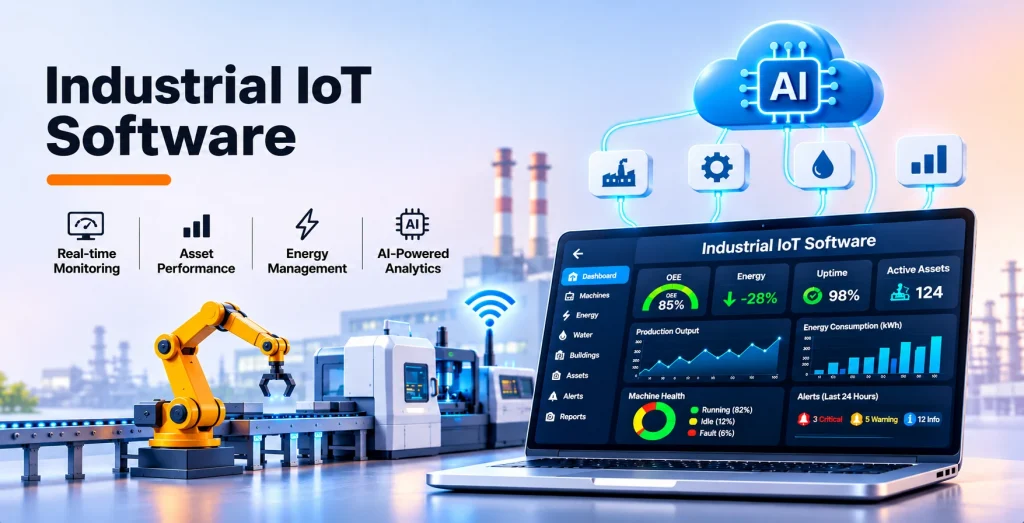
Did companies used to check every platform separately, relying on limited, custom-built tools for each machine, meter and system? Industrial IoT solves these gaps. It combines hardware, such as sensors, smart meters and gateways, with a software platform that collects, analyzes and displays all plant data on a single dashboard.
Without it, factory floors face surprises. A machine can fail without warning, and scattered data across logbooks, spreadsheets and separate meters leaves teams with no clear view until output has already fallen.
These gaps directly increase costs when repairs happen only after equipment has already failed, and idle machines, leaks and wasted power go unnoticed, which keeps utility bills high. Industrial IoT software closes these gaps by bringing all plant data onto one platform and providing real-time monitoring and timely alerts, so small faults are fixed before they turn into unplanned downtime.
What Is an All-in-One Industrial IoT Platform?
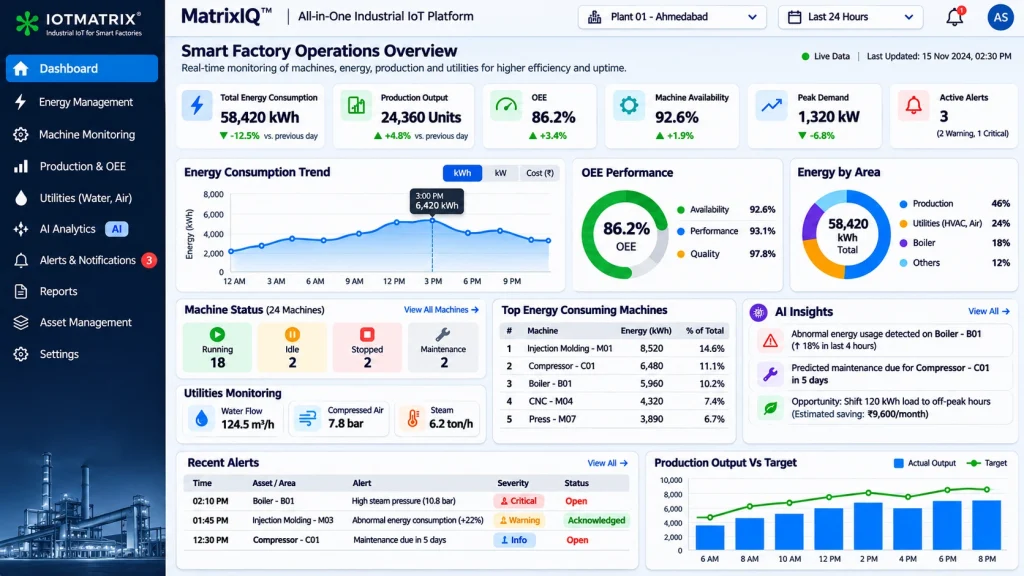
An all-in-one industrial IoT platform connects machines, energy meters, sensors and other assets, and gives each department, such as production, maintenance, energy, quality, facility and management, the data it needs from a single dashboard asset, and lets teams monitor everything from a single dashboard. It collects, stores and analyzes data from every site, so you do not need separate tools for machines, energy and water to optimize each platform seperately.
Think of it as a control room for your entire operation that you can open on a computer or phone.
Most platforms contain five core layers:
- Connectivity: Gateways read data from PLCs, SCADA systems, meters and sensors.
- Data storage: A time-series database saves every reading with its date and time, which helps operators understand what happened and when.
- Dashboards and alerts: Dashboards show real-time data, reports and notifications, and when a fault occurs, they pinpoint where it happened and alert operators and managers immediately.
- Analytics: Rules and machine learning spot unusual behavior and predict failures.
- Integration: APIs link the platform to ERP, MES and maintenance software.
In plant data projects, a lack of data rarely causes the problem. Disconnected systems that cannot share what they know cause it. A unified platform solves exactly that problem.
Finding out about faults only after the line stops? Get one live view of every machine, meter and site, with early alerts before downtime hits.
Book a Free IOTMATRIX DemoHow Does a Unified Industrial IoT Platform Connect Machines, Energy and Water?
A unified industrial IoT platform connects machines, energy, water, solar plants and building systems through gateways and standard industrial protocols. The gateways collect readings from each asset, and the platform records every reading with its asset, site, area and time. Teams then view all the data together, whether it comes from a production line, a rooftop solar array or a remote tower.
Machines and production equipment
Gateways connect to equipment through common protocols such as Modbus, OPC UA and MQTT. They collect run status, cycle count, speed, temperature, vibration, pressure and fault codes. For machines with no digital output, add-on sensors and retrofit modules capture the data, so you can keep your working machines and still gain full visibility.
Energy
Smart meters and power analyzers report voltage, current, power factor, demand and total consumption. When energy data sits beside production data, you can see how much power each machine, shift or product consumes. That detail helps far more than a single monthly electricity bill.
Water and utilities
Flow meters, level sensors and pressure sensors track water use, tank levels and pump performance. The same method covers compressed air, steam and gas, which often hide significant costs in a factory.
Solar power plants
Solar assets generate valuable data that many plants never use. The platform reads inverter output, string current, panel temperature, irradiance and battery storage status, then compares actual generation with expected generation.
This comparison helps your team:
- Spot underperforming strings, dirty panels or inverter faults quickly.
- See how much of your plant loads solar covers at any hour.
- Decide when to draw from the grid, the battery or the solar array.
Building management
Commercial and factory buildings use a large share of their energy on cooling, ventilation and lighting. The platform connects to HVAC units, chillers, air handling units, lighting controllers and indoor air quality sensors, usually through BACnet or Modbus.
With this data, facility teams adjust temperature setpoints by zone, switch off lighting in empty areas and schedule cooling around real occupancy. Fire alarm and access control status can also appear on the same dashboard, so security and facility staff work from one view.
Why combining them helps
When all these data streams share one platform, cause and effect become easy to see:
- Extra current draw on a pump often signals bearing wear long before the bearing fails.
- Water use that suddenly climbs on one line usually points to a leak or a stuck valve.
- Operators can spot machines that keep running during breaks and stop the wasted power.
- On a clear day, low solar output points to a failing inverter or dirty panels.
- Tower batteries that discharge faster than normal warn of failure before the next power cut.
- Cooling systems running at full load in an empty building waste energy every night.
Operators struggle to find these links when each system reports on its own.
What Are the Key Features of Industrial IoT Software?
The key features of industrial IoT software include real-time data collection, custom dashboards, instant alerts, historical reports, OEE tracking, maintenance support, strong security and open integration. Together, these features decide whether the platform becomes part of daily work or turns into another unused screen.
1. Real-time data collection
The software reads real-time data continuously from many machines and sensors, so your team can monitor machine status, running hours, downtime and operating condition on live dashboards. Look for “store and forward” capability at the edge. It saves data locally when the network drops and sends it later, so you never lose a reading.
2. Custom dashboards
Operators need a quick view of line status, while managers need trends and comparisons. Right platforms let each user build personal screens with simple drag-and-drop widgets.
3. Alerts and notifications
Alarms should reach people by email, SMS or mobile app. Escalation rules pass an alert to the next person when the first person does not respond.
4. Historical data and reports
Long-term storage lets you know trends and compare months. Automatic reports on production, downtime and energy save hours of manual work every week.
5. OEE tracking
Overall equipment effectiveness (OEE) combines availability, performance and quality into one score. Automatic OEE calculation shows where you lose capacity and why.
6. Maintenance support
Since issues can arise at any time, the platform tracks machine condition and triggers service when needed, not by calendar date.
7. Security and access control
Industrial systems need encryption, user login, audit logs and role-based permissions. The ISA/IEC 62443 series of standards on industrial cybersecurity gives you a useful reference when you review vendors.
8. Open integration and scalability
Open APIs and standard protocols protect you from vendor lock-in. The platform should grow from one line to many plants without a redesign.
How Does an IIoT Platform Enable Centralized Plant Monitoring and Control?
An IIoT platform enables centralized plant monitoring and control by bringing every connected asset into one live view. Authorized users watch performance, receive alerts and, where policy allows, send commands or setpoint changes back to equipment, all from one place.
One screen for the whole plant
A central dashboard shows production counts, machine status, energy load, water use and active alarms together. Supervisors see at a glance which lines run, idle or stop, and they open any machine for more detail.
Visibility across multiple sites
If your company operates several plants, solar sites, towers or buildings, the platform merges their data into one view. Leaders compare sites, learn from top performers and spot weak areas without waiting for month-end reports.
Remote access
Secure web and mobile access lets engineers check status and diagnose problems from anywhere. Response times for night-shift issues drop, and unnecessary trips to the site decrease.
Simple automation
Many platforms follow rules that your team defines, such as:
- Start a standby pump when pressure drops.
- Switch off non-critical loads during peak power demand.
- It sends a maintenance request when a machine reaches a set running time.
Dedicated safety systems must continue to handle safety-critical functions. The IoT platform adds a supervisory layer on top and never replaces them.
Smoother shift handovers
Digital logs and event histories show the next shift exactly what happened. That clarity cuts miscommunication, one of the quiet causes of repeat downtime.
AI-Powered Monitoring and Analytics for Smarter Industrial IoT Operations
AI-powered monitoring and analytics understand how each asset normally behaves, detect changes and predict failures before they cause downtime. Instead of relying only on fixed alarm limits, the software examines many signals at once and notices patterns that people miss.
Anomaly detection
The software analyze each machine’s normal behavior and warns you when several readings change together in an unusual way, before any single alarm triggers.
Predictive maintenance
The software studies trends in vibration, heat, power draw and running hours, and estimates when a motor, bearing or pump may fail. Your team then repairs the part during a planned stop instead of reacting to a breakdown. The same approach applies to tower batteries and solar inverters.
Energy optimization
Analytics show where energy is wasted, such as idle machines, inefficient loads and demand peaks, so teams can shift loads, fix schedules and cut waste. In buildings, cooling adjusts to actual occupancy.
Quality insights
When engineers compare process settings with quality results, they identify the conditions that produce defects and control those conditions more tightly.
What Is the Difference Between an IIoT Platform and Traditional Monitoring Systems?
An IIoT platform connects, scales and drives decisions with analytics, while traditional monitoring systems work locally, cover limited areas and mostly show current values. A traditional tool tells you what is happening on one machine. An IIoT platform tells you what is happening across the plant, why it is happening and what may happen next.
| Basis of difference | Traditional Monitoring | Industrial IoT Platform |
|---|---|---|
| 1. Data scope | One machine or area | Machines, energy, water, solar, towers and buildings together |
| 2. Setup | Local and isolated | Edge, cloud or hybrid, fully connected |
| 3. Analytics | Basic alarms and trends | AI-based detection and prediction |
| 4. Access | Local screen or control room | Web and mobile, secure remote access |
| 5. Integration | Limited or custom-built | Open APIs for ERP, MES and CMMS |
| 6. Growth | Costly to expand | Easy to add assets and sites |
| 7. Maintenance | Reactive or calendar-based | Condition-based and predictive |
| 8. Reports | Manual exports | Automatic, scheduled reports |
| 9. Alerts | Local alarms only, triggered once a limit is crossed | Email, SMS and mobile app alerts with escalation rules |
| 10. Data storage | Limited or short-term history | Long-term time-series data for trends and comparison |
| 11. Energy and utility visibility | Separate meters, relies on the monthly bill | Live energy and water tracking at machine, line and plant level |
| 12. Multi-site view | Each site must be checked separately | All sites compared on a single dashboard |
Why Choose IOTMATRIX as Your Industrial IoT Platform Partner?
IOTMATRIX is an industrial IoT platform that brings machine, energy and water monitoring into one connected system for manufacturers. It serves organizations that want clear, centralized visibility without managing several disconnected tools.
Key features of IOTMATRIX
- End-to-end operation monitoring: Track machine status, running hours, downtime and operating condition across every line, shift and site.
- End-to-end energy monitoring: Measure power, water and other utilities at machine, line and plant level to find waste and cut costs.
- Legacy and old machine connectivity: Retrofit sensors and gateways capture data from, and where permitted control, older machines that have no digital output, so you keep your existing equipment.
- One platform for all assets: Machines, power, water, solar, telecom sites and building systems share a single environment.
- Live dashboards and alerts: Operators, maintenance teams and management each get views and notifications that fit their roles.
- AI-assisted analytics: Pattern detection and predictive insights support maintenance and efficiency decisions.
- Flexible connectivity: The platform supports common industrial protocols such as Modbus, OPC UA and MQTT.
- Hands-on support: The team guides you through planning, installation, training and ongoing improvement.
Are late repairs and hidden energy waste raising your costs? Move to condition-based maintenance from one dashboard.
Talk to our IoTMatrix teamBuild a Smarter Factory with One Connected Platform
Industrial IoT software gives manufacturers a practical way to see and manage their whole operation from one place. By linking machine, energy, water, solar, tower and building data, it supports centralized monitoring, AI-driven insight and condition-based maintenance, which cut waste and improve reliability. Compared with traditional monitoring tools, it offers wider visibility, easier growth and a deeper understanding of what happens on the floor.