⚙️ 1. Centralized Monitoring & Control
FDM integrates all building systems — energy, lighting, HVAC, water, and security — into a single unified platform, giving facility managers real-time visibility and control from anywhere.
A Smart Building Management System (BMS) is an integrated digital platform that uses IoT, automation, and data analytics to monitor, control, and optimize various building operations — such as energy, HVAC, lighting, water, safety, and security systems — from a single interface.
By connecting sensors, controllers, and equipment across the building, a BMS provides real-time visibility, intelligent automation, and centralized control, ensuring maximum comfort, safety, and energy efficiency.
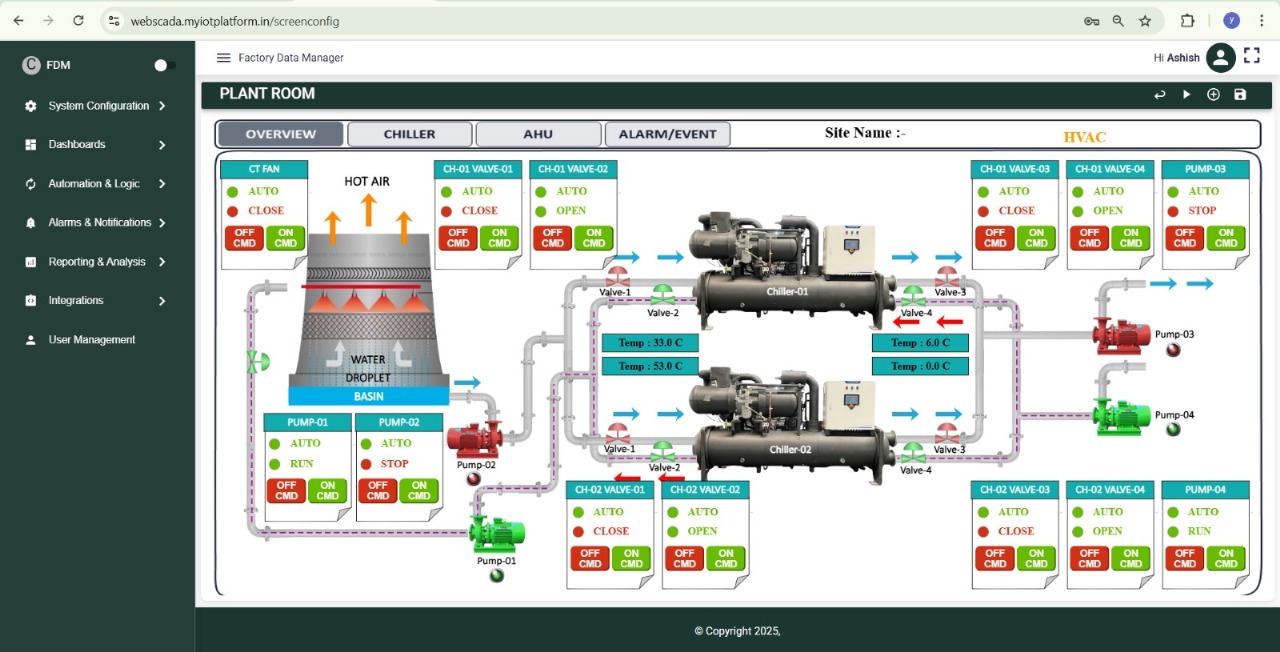
Monitor and control power, lighting, HVAC, and water systems
Automate operations based on occupancy, time, or environmental conditions
Receive alerts and notifications for faults or abnormal parameters
Generate reports and analytics for performance tracking and optimization

A Smart BMS enhances building performance by:
💡 In Short, a Smart Building Management System turns an ordinary facility into a connected, efficient, and intelligent environment — where every system works together to deliver better comfort, control, and cost savings.
The BMS connects with building equipment such as HVAC systems, lighting panels, water pumps, energy meters, and security devices using communication protocols like Modbus, BACnet, or MQTT. All data flows into a centralized IoT platform such as FDM for unified monitoring.
Sensors and controllers continuously capture real-time parameters — temperature, humidity, occupancy, energy use, tank levels, and equipment status — from across the building. This data is securely transmitted to the central BMS software.
All collected data is visualized through interactive dashboards and KPIs, allowing facility managers to view system performance, detect anomalies, and identify improvement areas.
The BMS intelligently automates lighting, HVAC, and water systems based on occupancy, time schedules, or environmental conditions — optimizing energy use without compromising comfort.
Automatically generated reports and trend analyses help management track performance, energy efficiency, and comfort levels.
These insights guide data-driven decisions for continuous optimization and sustainability.
Modern buildings are becoming more complex — with multiple systems for lighting, HVAC, energy, water, and security running independently. Without proper integration, this leads to high energy costs, inefficiencies, manual monitoring, and reduced comfort for occupants.
A Smart Building Management System (BMS) solves these challenges by bringing all building operations under one intelligent, connected platform, allowing real-time monitoring, control, and automation.
🌍 In Summary
A Smart Building Management System is no longer optional — it’s a necessity for organizations that want to make their facilities energy-efficient, intelligent, and future-ready.
A Smart Building Management System (BMS) is ideal for any facility that wants to improve energy efficiency, comfort, and operational control through automation and data-driven insights. It is suitable for a wide range of buildings and organizations, including:
FDM integrates all building systems — energy, lighting, HVAC, water, and security — into a single unified platform, giving facility managers real-time visibility and control from anywhere.
By analyzing power consumption patterns and automating operations, FDM helps reduce energy wastage, optimize load distribution, and lower utility costs significantly.
FDM converts raw building data into actionable insights through interactive dashboards and automated reports, enabling smarter decision-making and performance benchmarking.
Set custom rules and alarms for temperature, lighting, or equipment status. FDM automatically notifies users of abnormalities and can trigger corrective actions instantly.
FDM ensures optimal indoor conditions, reduced downtime, and smarter use of resources — supporting green building initiatives and improving overall occupant comfort.