1. Real-Time Temperature & Humidity Monitoring
Continuously track temperature, humidity, and equipment status with live dashboards — ensuring storage conditions stay within safe limits at all times.
A Smart Cold Storage Condition Monitoring System is an intelligent IoT-based solution that continuously tracks and manages temperature, humidity, power, and equipment performance inside cold storage and refrigeration facilities.
It connects temperature sensors, controllers, and PLCs to a centralized IoT platform like Factory Data Manager (FDM), allowing real-time monitoring, automated alerts, and data-driven control to ensure the safe and efficient preservation of perishable goods.
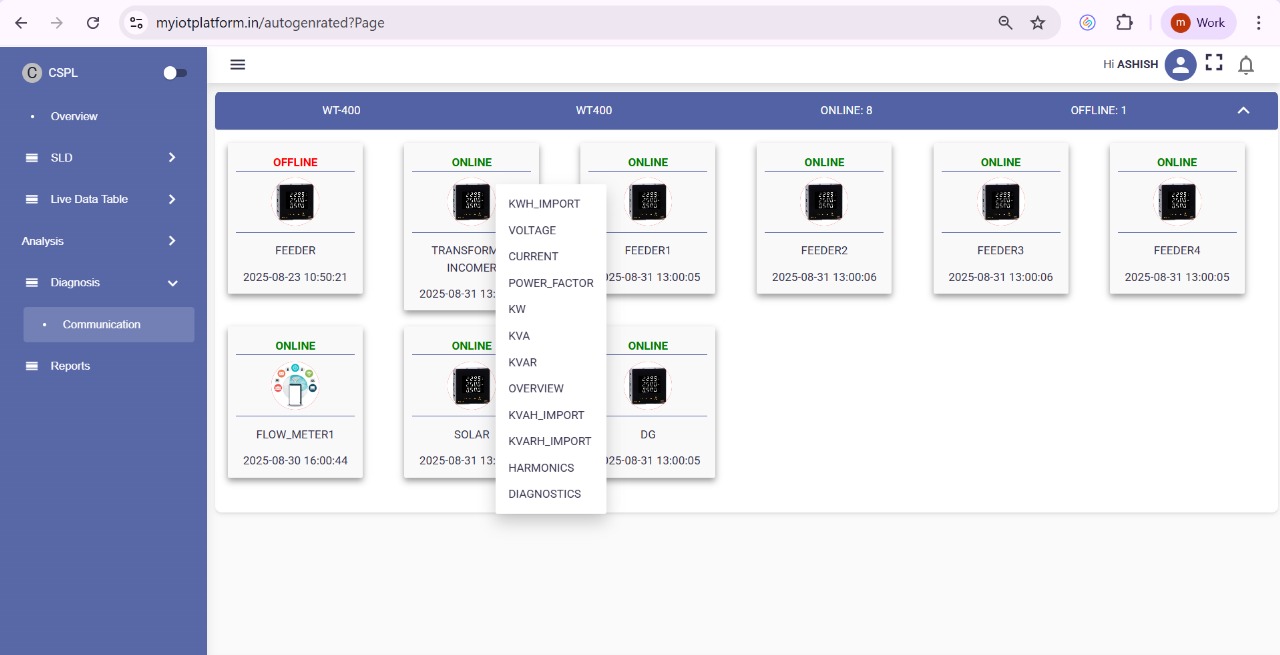
Monitor temperature, humidity, and cooling equipment status in real time
Detect and alert for deviations from preset conditions
Record and report data for quality compliance and audits
Optimize energy consumption and equipment performance

The system ensures that cold storage units always operate within the required environmental parameters. It helps industries:
In short, a Smart Cold Storage Condition Monitoring System provides end-to-end visibility and control of cold storage conditions — ensuring product safety, energy efficiency, and operational reliability through real-time monitoring and automated alerts.
The Smart Cold Storage Condition Monitoring System connects IoT sensors and controllers to a centralized software platform — enabling real-time tracking, alerting, and control of temperature-sensitive environments. Here’s how it works step-by-step 👇
Smart temperature, humidity, and door sensors are installed across the cold storage area. These sensors communicate with PLCs, controllers, or IoT gateways via standard protocols such as Modbus or MQTT, ensuring seamless data collection.
The system continuously gathers live readings of temperature, humidity, compressor status, and power supply. This data is transmitted securely to the Factory Data Manager (FDM) platform hosted on-premises or in the cloud.
All parameters are displayed on interactive dashboards with color-coded KPIs. FDM analyzes variations, trends, and threshold breaches — allowing users to spot inefficiencies, performance drops, or environmental risks instantly.
If temperature or humidity levels move beyond the defined range, the system triggers instant alerts via SMS, email, or mobile app notifications. Automated rules can also control equipment like compressors or fans to restore conditions immediately.
FDM automatically generates daily and monthly reports showing temperature trends, energy usage, and downtime logs. These reports help in regulatory compliance (HACCP, FDA, GMP) and performance optimization.
Cold storage facilities play a critical role in preserving perishable products such as food, beverages, pharmaceuticals, and chemicals. Even a small deviation in temperature or humidity can lead to product spoilage, financial loss, and non-compliance with industry standards.
Traditional cold storage monitoring methods — like manual temperature checks or periodic inspections — are slow, error-prone, and reactive, often identifying issues only after damage has occurred.
A Smart Cold Storage Condition Monitoring System eliminates these risks by providing real-time visibility, instant alerts, and automated control, ensuring consistent environmental conditions at all times.
A Smart Cold Storage Condition Monitoring System is vital for industries where temperature control is critical — helping maintain product integrity, operational efficiency, and regulatory compliance through real-time, IoT-enabled intelligence.
A Smart Cold Storage Condition Monitoring System is essential for any organization that relies on temperature-controlled environments to maintain the quality, safety, and shelf life of their products. It provides real-time visibility and control for a wide range of industries and applications.
Continuously track temperature, humidity, and equipment status with live dashboards — ensuring storage conditions stay within safe limits at all times.
Get automatic SMS, email, or app notifications whenever temperature or humidity deviates from the preset range — enabling quick corrective action before damage occurs.
Automatically record and store historical data for audit-ready reports. Simplify compliance with HACCP, FDA, GMP, and WHO standards through accurate documentation.
Monitor compressor cycles, power usage, and performance to identify inefficiencies. Optimize equipment operation and reduce energy costs through data-driven control.
Ensure consistent storage conditions to protect perishable goods, extend shelf life, and prevent costly product spoilage — securing both quality and brand reputation.