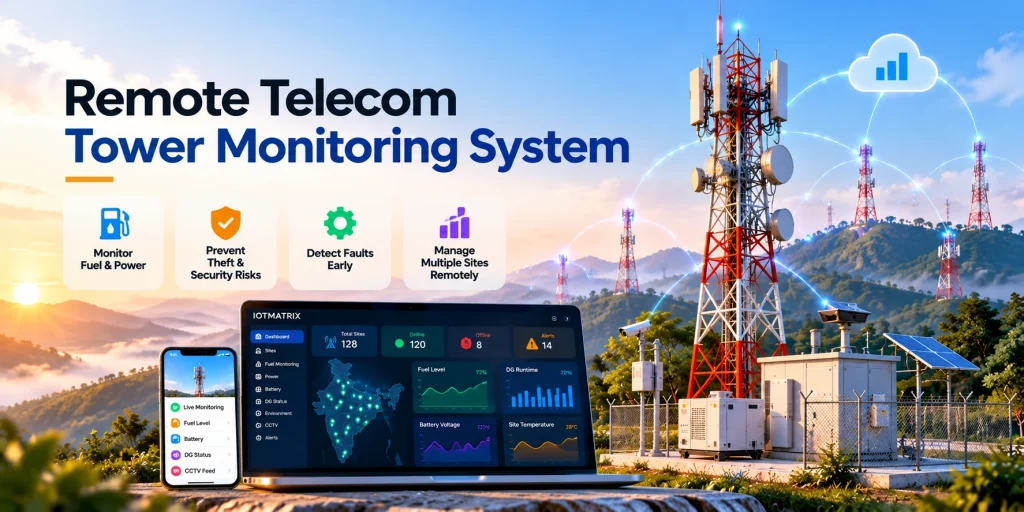
If you could monitor every tower site, detect potential failures early, and respond to theft /faults alerts without waiting for a site visit instantly? AI and IoT automation are making this possible through smarter, connected telecom infrastructure.
Lower diesel bills, fewer fuel thefts and towers that stay online without a technician at every site that is what a remote telecom tower monitoring system delivers. It connects your DGs, tower facilities, batteries and meters to one live dashboard, while AI flags faults and unusual activity as they start. Telecom operators and TowerCos use it to cut OPEX, respond faster and prove SLA compliance.
What Is a Remote Telecom Tower Monitoring System?
A remote telecom tower monitoring system is an IoT-based solution for both hardware and software that collects real-time data from tower site equipment such as DGs, batteries, energy meters, environmental conditions and security sensors, and sends it to a centralized dashboard. It lets operators track power, fuel, equipment health and security, and control assets such as generators, AC, lighting and other facilities from anywhere without visiting the site.
A IoT Based modern system covers:
- Real-time power monitoring (grid, DG, solar and battery)
- DG fuel level and running-hour tracking
- Battery health and performance alerts
- Site security and unauthorized access detection
- Remote start/stop and power-source switching
- Automated SLA and compliance reporting
- Smart Energy and Weather Planning
Key Components of a Remote Telecom Tower Monitoring System?
A remote telecom tower monitoring system builds up in layers, from basic data capture to AI-driven control.
- Sensors and meters: Measure DG fuel level, running hours, grid and DG energy, battery condition and site security events.
- IoT gateway: Collects data from your existing equipment through Modbus, MQTT and RS485, so nothing needs to be replaced.
- Connectivity: Sends site data to the cloud, built to keep working at remote, low-connectivity towers.
- Cloud IoT platform: Stores and organizes data from every site in one place, giving you a single source of proven data across your network.
- Centralized dashboard: Shows live status, alarms and historical trends across your whole network.
- AI analytics: Detects abnormal fuel drops, unusual site activity and battery or DG drift before they become outages.
- Visual theft detection: Captures photo evidence and sends instant alerts to phone or WhatsApp.
- Remote control: Starts and stops DGs and switches power sources without a site visit.
- SLA and compliance reporting: Tracks uptime, response times automatically and produces audit-ready reports.
What Is an AI-Powered Remote Telecom Tower Monitoring System?
An AI-powered remote telecom tower monitoring system uses connected sensors that link the equipment at unmanned tower sites to one cloud dashboard and uses artificial intelligence to interpret the data. It keeps towers running at the lowest possible cost, so your team no longer needs to send a technician to check each site.
Four functions work together:
- Monitoring captures live data of tower performance, fuel, power, batteries and security.
- Analytics uses AI to find theft, faults and inefficiency in that data.
- Control lets operators start or stop DGs and switch power sources remotely.
- Site management brings alerts, predictive maintenance and SLA reporting into one workflow.
Difference Between Traditional Tower Monitoring and AI-Based Monitoring
| Parameter | Traditional Monitoring | AI-Based Monitoring |
|---|---|---|
| Detection logic | Fixed thresholds, the same rule for every site | Analyzes each site’s normal behavior and flags deviations |
| Fuel anomaly analysis | Shows the drop, but not the cause | Separates refuelling, normal consumption and suspicious drops |
| Alert intelligence | High alarm volume with many false positives | Fewer, context-rich alerts based on exact events |
| Theft evidence and verification | An alarm code or a reading | Visual detection can attach photos to the alert |
| Fault and failure prediction | Reacts after a breakdown or breach | Flags battery, facilities and DG performance drift before failure |
| Maintenance strategy | Calendar-based servicing | Condition-based, triggered by actual equipment health |
| Response and remote operations | Often needs a site visit to diagnose and fix | Instant alerts to phone and messaging apps, with remote DG control |
| Network-wide visibility | Site-by-site checks and manual logs | Unified dashboard with trends and fleet-wide comparison |
| SLA and compliance reporting | Compiled manually and hard to audit | Automated uptime and response-time reports |
| Scalability | Effort grows with every added site | One platform handles ten towers or hundreds |
How IoT Sensors and Connected Equipment Collect Site Data
IoT sensors, meters and connected equipment collect real-time data from the assets that matter most at a tower, such as the DG, energy meters, power supply, fuel tank and site access points. They measure fuel level, running hours, grid and DG energy, security events, environmental and battery condition.
An IoT gateway at the site gathers these readings, along with data from existing controllers, using standard protocols such as Modbus, MQTT and RS485. Because the gateway reads equipment in place, it works with different brands and connectivity standards without replacing anything. It then sends the data to the cloud over the available network, and it is built to keep working at remote, low-connectivity areas.
How the Data Collection Process Works
- Edge Data Acquisition: IoT sensors capture real-time signals on power, fuel, battery health, temperature and generator status.
- Equipment Integration: Smart meters, generator controllers and battery systems, tower network share data through Modbus, MQT, RS485, SNMP, OPC UA and LoRaWAN so you keep your existing hardware to get real-time data.
- Reliable Data Transmission: IoT gateways send data to the cloud over 4G LTE, 5G, Ethernet or other supported technologies, even where signal is weak.
- AI-Powered Anomaly Detection: The Telecomatrix platform analyses against normal operating patterns to detect unusual readings, fuel theft and early signs of hardware failure.
- Real-Time Alerts and Action: Operators get instant alerts on faults or theft, fuel level anomalies and power supply failures, and take action remotely from the dashboard.
How a Centralized Platform Connects Multiple Telecom Tower Sites
IoT gateways at each tower send site data over the available communication networks to a centralized cloud platform. This brings every site into one view, so your team no longer has to check towers one by one. From a single dashboard, operators monitor the power source, fuel level, tower networks, battery condition, alarms and security events across the whole network. They also review site performance, spot recurring problems and receive site-specific alerts that show which tower needs attention and why.
The same platform lets you compare sites across the fleet, such as finding which towers use the most diesel, so you can fix the biggest losses first. It works the same way for ten towers or a hundred, so you can start with a small pilot and scale up across your network as the results come in.
Benefits of Remote Telecom Tower Monitoring Systems
The value of remote monitoring comes from three shifts from estimating to measuring, from reacting to predicting, and from visiting to controlling. Each benefit below follows from one of them.
Reduce Diesel Consumption and Operating Costs
Most diesel waste hides in idle DGs, poor load and badly timed source switching. The system ties fuel level, running hours and load together, so you can compare consumption per running hour across every site and fix the outliers at the source.
Detect and Prevent Fuel Theft in Real Time
A level reading alone can’t tell a refuel from a theft. The platform checks each drop against that site’s normal pattern, and AI-based visual detection can attach photo evidence, so your team can verify and act at once.
Improve Tower Uptime with Early Fault Detection
Batteries and DGs weaken for days or weeks before they fail. AI spots drift, so maintenance follows the condition of the equipment, not the calendar, and your team fixes faults before they cause outages.
Cut Unnecessary Site Visits with Remote Control
Many visits exist only to check status, start a generator or switch a power source. Remote DG control moves those tasks to the dashboard, so technicians travel only for physical work.
Reduce Response Time with Real-Time Site-Specific Alerts
Alerts reach your team by phone or WhatsApp and show which tower is affected and why. The right team responds without first diagnosing the problem, and fewer false alarms keep engineers focused on what matters.
Optimize Grid, DG, Solar and Battery Usage
The platform tracks every power source together, so your team sees which source carries the load and how efficiently. This supports lower fuel use, fewer outages and proof that solar investments deliver.
Prove SLA Compliance with Automated Reporting
The system logs uptime, response times and maintenance turnaround automatically and produces audit-ready reports. It also flags sites that repeatedly miss targets before penalties follow.
Scale from a Pilot to Your Entire Network
One platform handles ten towers or a hundred, and it reads existing equipment through Modbus, MQTT and RS485, so you can expand site by site without replacing hardware.
See what remote monitoring would save on your own towers.
Run a pilot on a few sites and measure diesel use, fuel-loss incidents, site visits and uptime yourself.
Talk to the IOTMATRIX teamKey Features of a Remote Telecom Tower Monitoring System
The right features decide whether a system gives you alarms or real control over cost and uptime. Look for these eight.
Real-Time Monitoring of Power, Fuel and Batteries
The system streams live data on grid, DG, solar and battery power, DG fuel level and running hours, and battery condition. Every other feature depends on this data.
AI-Powered Fault and Anomaly Detection
AI compares incoming data with each site’s normal behavior to flag abnormal fuel drops, unusual activity and early signs of battery or DG failure, so your team acts before an outage.
Visual Fuel Theft Detection
AI-based activity detection captures photos and sends instant alerts to phone or WhatsApp, so your team verifies an incident before anyone travels.
Remote DG Control and Power-Source Switching
Operators start or stop DGs and switch between grid, DG, solar and battery from the dashboard, without a site visit.
Condition-Based Predictive Maintenance
The system tracks equipment health and alerts your team when performance drifts, so servicing follows actual conditions, not a fixed calendar.
Centralized Multi-Site Dashboard
One dashboard shows live status, alarms and trends for every tower, with fleet-wide comparison to find the sites with the highest diesel use or fastest battery wear.
Multi-Protocol, Multi-OEM Compatibility
The gateway reads existing DGs, meters and controllers through Modbus, MQTT and RS485, so you keep your current hardware.
Automated SLA and Compliance Reporting
The system records uptime, response times and maintenance turnaround, and it produces audit-ready reports without manual compilation.
How Remote Control Automates Telecom Tower Site Operations
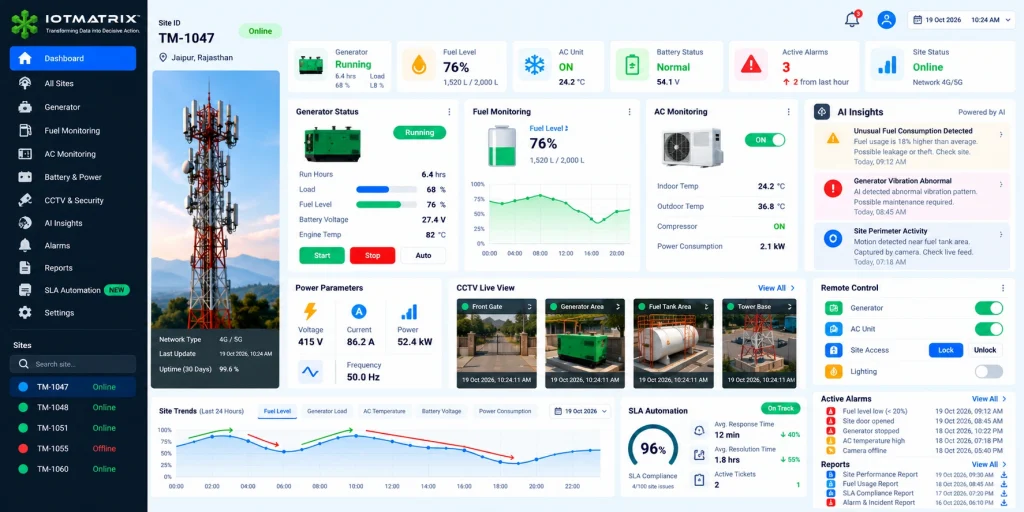
Remote control moves routine site tasks from the field to the dashboard, and automation lets the telecom tower monitoring system handle many of them on its own. Operators start generators, switch power sources and respond to faults without travelling. Because these commands act on live equipment, the controls around them matter as much as the commands themselves.
4 Core Operations Automated by Remote Control
- DG start and stop: Operators start or stop generators remotely, with safety checks confirming that the command suits the site’s conditions.
- Power-source switching: The platform switches the site between grid, DG, solar and battery power, and confirms the result from live data.
- Site status checks: Operators verify fuel level, power source and battery condition from the dashboard, so nobody travels just to look.
- Routine energy management: Rule-based automation runs the site on the most efficient source available and cuts idle DG runtime, with no manual decision at each switch.
Start and Stop DGs Remotely with Built-In Safety Checks
Operators start or stop a DG from the dashboard, and safety checks confirm that the command suits the current site conditions first. For example, the system verifies that the DG is not already running and that no fault blocks a start. If a check fails, the command stops and the operator sees why. This protects equipment and field staff from unsafe or mistaken commands.
Switch Power Sources Remotely and Confirm the Result
From the same screen, operators switch between grid, DG, solar and battery power. After each command, the platform checks the outcome against live data such as the active source, power output and fuel level, and reports whether the action worked. Your team no longer has to assume a command succeeded or send a technician to confirm it.
Automate Routine Site Tasks with Custom Rules
Many site tasks follow a fixed pattern, such as moving to backup power when the grid fails or cutting idle DG runtime. Rule-based automation lets the platform perform these tasks itself, using live data and the rules your team sets. Every site follows the same logic, and operators spend their time on the exceptions that need judgement.
Control Who Can Run Critical Commands
Not every user should be able to run every command. Role-based access limits each person to the sites and actions that fit their job, and critical actions can require a second person’s approval before they run. This lowers the risk of accidental or unauthorized changes across a large network.
Track Every Remote Command with a Full Audit Trail
The platform records each remote command, including who issued it, which site it affected and when it ran. An operator can audit every action remotely from the dashboard, without visiting a site or asking field staff what happened. Your team gets a clear history for troubleshooting, accountability and compliance reviews, and it can see exactly what happened if an incident needs investigation.
Why Centralized Multi-Site Management Matters for Telecom Operators
Telecom operators rarely manage one tower. They manage dozens or hundreds, spread across regions, each with its own power setup, equipment brands and fault history. Centralized multi-site management brings all of them into one dashboard, so your team runs the network as a whole instead of tower by tower.
Monitoring Hundreds of Tower Sites from One Dashboard
The dashboard shows live status for every connected tower, including the active power source, fuel level, battery condition, alarms and security events. Operators see immediately which sites need attention and do not have to call or visit each one. The same telecom tower monitoring system handles ten towers or hundreds, so you can start with a pilot and expand site by site.
Site-Wise Performance, Energy, and Downtime Reports
The platform builds reports for each site, covering performance, energy use and downtime. Your team sees which towers use the most diesel, which lose the most uptime and how each site’s energy mix changes over time. Historical data supports planning for refuelling, maintenance and upgrades, so decisions rest on real numbers and not estimates.
SLA Tracking and Critical Alarm Escalation
The system records uptime, alert response times and maintenance turnaround for every site and produces audit-ready SLA reports. When a serious alarm gets no response in time, the platform sends it to the next person in line, so important faults never wait unseen. Your team spots recurring gaps early and avoids penalties.
Remote Troubleshooting Before Sending Field Technicians
When an alarm fires, operators open the site from the dashboard and check live fuel, power and battery data and the recent event history. Many faults, such as a DG that needs a restart or a power source that needs switching, they fix remotely. Technicians travel only when physical work is needed, and they arrive knowing the fault and the spare they need.
Comparing Site Performance to Identify Operational Issues
With every site’s data in one place, your team compares towers directly. A site that burns far more diesel than similar ones, a battery bank that degrades faster than the rest or a tower that raises repeated alarms stands out at once. These comparisons show where to fix first, so effort goes to the sites with the largest losses.
How IOTMATRIX Transforming Telecom Tower Management with Emerging AI and IoT Technologies
IoT-Based Remote Monitoring of Generators and Power Systems
IoT sensors and meters sit on the DG, batteries, fuel tank and energy meters and stream real-time data to a gateway. The gateway reads existing equipment through Modbus, MQTT and RS485 and sends the data to the cloud. Your team sees fuel level, running hours, grid and DG energy, and battery condition without visiting the site, and keeps its current hardware.
Remote Control for Faster Site Operations
Operators start or stop DGs and switch between grid, DG, solar and battery power from the dashboard. Routine tasks that once needed a truck roll now take minutes, and technicians travel only when physical work is needed.
AI-Powered Theft Detection, Anomaly Detection and Predictive Maintenance
AI learns what normal energy and fuel use looks like for each site and flags deviations. It separates a refuel from a theft, and a normal load change from a failing DG, so alerts are specific and false alarms drop. When something looks wrong at the tower, AI-powered visual detection captures photos of the suspicious activity and sends an instant alert to phone or WhatsApp, so your team verifies the incident before anyone travels. The same AI also watches battery and DG performance drift, so servicing follows equipment condition and not a fixed calendar.
Centralized Management of Multiple Telecom Tower Sites
A cloud platform brings every connected site into one dashboard, with live status, alarms, historical trends and site-by-site comparison. The same platform handles ten towers or hundreds, so you can start with a pilot and scale.
Data Analytics for Better Operational Decisions
The platform turns stored site data into reports and trends. Your team sees which towers use the most diesel and lose the most uptime, plans refuelling and maintenance from real numbers, and produces audit-ready SLA reports without compiling them by hand.
AI Chatbot for Cell Tower Site Monitoring
An AI chatbot lets engineers ask questions about their towers in a simple conversational language, such as “Why did this site switch to DG last night?” , “Which towers used the most diesel this week?” or “which site is not running efficiently” It reads the site data and event history, then replies with a likely cause or a clear summary. Engineers get answers in seconds without searching through dashboards or waiting for a report. New team members diagnose faults with more confidence, and senior engineers spend less time on routine questions.
Digital Twins for Tower Asset Health and Lifecycle Management
A digital twin is a live virtual model of a tower’s equipment, such as its DG, batteries and power systems. It combines real-time data with equipment history, so your team can see an asset’s health, predict when it will wear out and plan replacement, not just react to failure. Over time, the twin also shows which equipment lasts longest and which sites wear it out fastest, which supports better purchasing and upgrade decisions.
Reduce Maintenance Costs with AI-Based Cell Tower Monitoring
An AI-based cell tower monitoring system reduces maintenance costs by finding problems early, fixing many of them remotely and sending a technician only when physical work is needed. TelecomMatrix is also built to cut utility costs by up to 30%, depending on site conditions.
Seven parts do the work:
- IoT Sensors capture real-time readings of fuel, power, running hours and battery condition.
- Data Analysis uses AI to spot battery and DG drift, abnormal fuel use and idle runtime before they become failures.
- Automated Alerts reach your phone or WhatsApp and show which tower is affected and the likely cause.
- Cloud Dashboard gives you one view of every tower, so you can see which sites need attention.
- Remote Control lets operators start or stop DGs and switch power sources without sending a technician.
- Predictive Maintenance flags equipment that needs attention early and schedules servicing before it breaks down.
- Automated Reports track uptime and response times and make it easy to see where you save money.
The result is fewer site visits, fewer emergency repairs, and technicians who arrive with the right spare and fix the fault in one trip.
Choosing the Best-Suited Telecom Tower Monitoring Solution Provider for Remote Sites
When choosing an AI-based telecom tower monitoring platform, consider the size of your network, the problems you face most, and how your sites are managed. A platform should include a generator monitoring system, telecom equipment fault detection, fuel theft alerts, and DG run-hour verification, along with centralized management of all your tower sites such as IoT platform-MatrixIQ. It should also work smoothly with your existing generators, fuel sensors, batteries, and power systems, helping you reduce fuel losses and keep sites running.
1. Compatibility with Existing Generators, Batteries, and Meters
Your towers already run DGs, batteries and meters from several brands, and replacing them all is slow and expensive. Ask which protocols and brands the platform supports, such as Modbus, MQTT and RS485, and whether it reads your equipment in place. If it needs new hardware at every site, your cost and rollout time both rise.
2. Secure Communication, User Access, and Data Protection
A monitoring platform can control live equipment, so security events and other features. Check that data is encrypted in transit, that each user sees only the sites and actions their role needs, and that critical commands need approval and leave a log. Also ask where your data is stored and who owns it.
3. Integration with Existing NOC and Maintenance Systems
The platform should fit the way operators already work. Ask whether alerts and events flow into your NOC tools, ticketing and maintenance systems, so a fault becomes a work order without anyone re-entering it.
4. Scalability Across Multi-Vendor Tower Infrastructure
A pilot on ten sites is easy. The real test is whether the same platform handles hundreds of towers, with equipment from different vendors, on one dashboard, with fleet-wide comparison and automated SLA reports. Scaling should mean adding sites, not adding systems.
5. Measuring ROI Through Energy Savings, Reduced Site Visits, and Uptime
Analyze the numbers before you start. Track diesel use per site, fuel-loss incidents, site visits and cost per visit, time to resolve faults, and uptime. Run a pilot on a representative group of sites, including at least one hard-to-reach tower, and compare it with a control group. Scale once the results prove the case.
Ready to take control of your tower sites?
TelecomMatrix gives you live visibility, AI-powered theft and fault detection, and remote control across every tower, without replacing your existing equipment.
Book a free demo